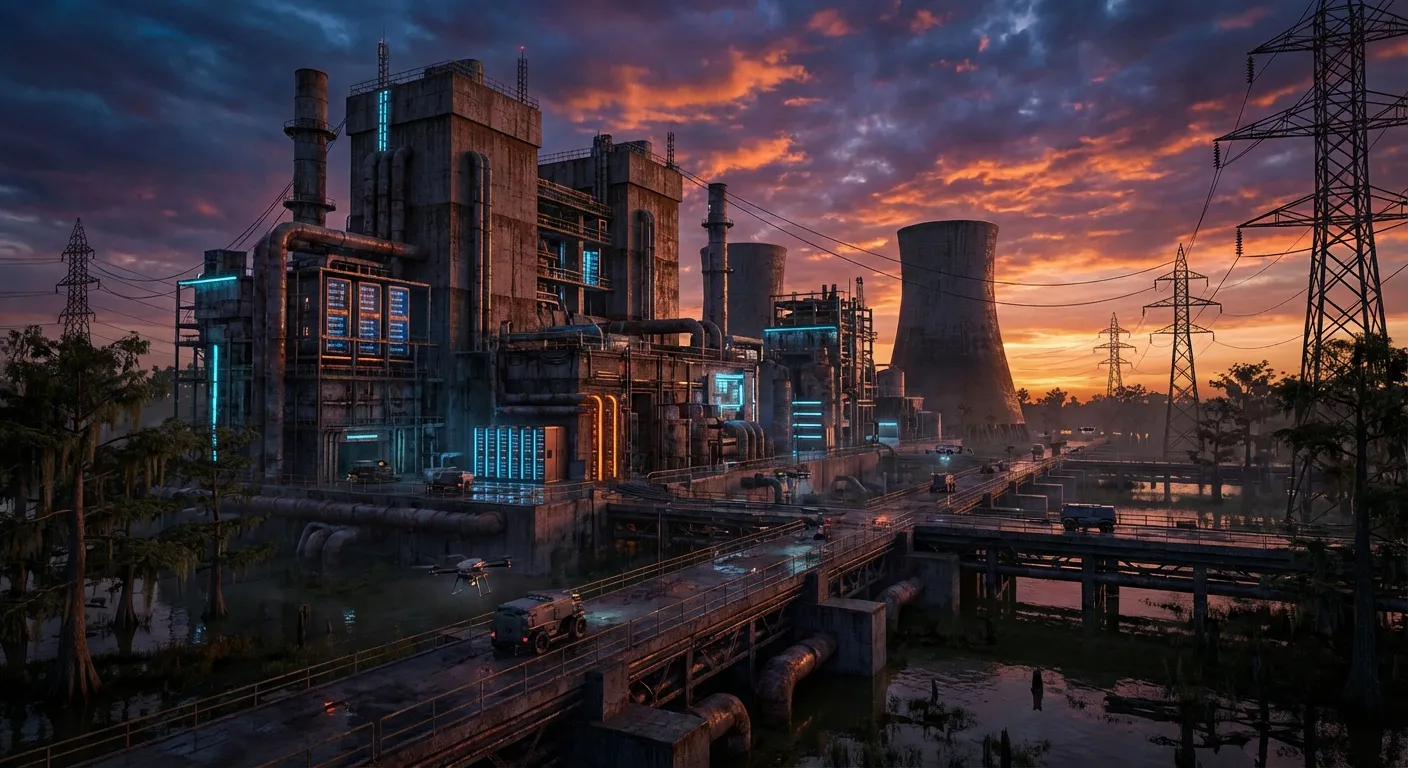
Meta just announced plans to build 10 gas-fired power plants in Louisiana. Not fund them. Not invest in them. Build them. Ten power plants generating 7.5 gigawatts of electricity—enough to power more than 5 million homes—all to feed a single AI data center complex.
Welcome to 2026, where Big Tech companies are becoming their own utilities.
The Hyperion Problem
Meta’s Hyperion campus in rural Richland Parish, Louisiana started as a $10 billion project announced in December 2024. Then it quietly expanded. Meta acquired an additional 1,400 acres. The budget ballooned to $27 billion through a joint venture with Blue Owl Capital. Mark Zuckerberg now says Hyperion will cover “a significant part of the footprint of Manhattan.”
The scale is staggering. But here’s what’s even more revealing: Meta couldn’t just plug into Louisiana’s existing power grid. There literally isn’t enough electricity. So Meta struck a deal with Entergy Louisiana to finance and build seven new gas plants on top of three already approved last year.
The 7.5 gigawatts of gas capacity alone represents a more than 30% increase to Louisiana’s entire grid capacity. Meta is also funding up to 2.5 gigawatts of renewable energy and battery storage. Total estimated cost for the power infrastructure: $11 billion.
Let that sink in. A social media company is spending $11 billion on power plants.
The Hidden Tax
This story isn’t just about Meta. It’s about what AI is doing to our power infrastructure.
Goldman Sachs projects that data center power consumption will boost core inflation by 0.1% in both 2026 and 2027. The U.S. Department of Energy expects AI energy demands to double or triple in the next few years, potentially consuming 12% of the country’s total energy by 2028.
The numbers are already hitting consumers. Residential electricity prices in the U.S. have risen 36% since 2020—from 12.76 cents per kilowatt-hour to 17.44 cents today. They’re projected to hit 19.01 cents by September 2027.
In Virginia’s “Data Center Alley,” nearly three-quarters of voters blame the facilities for rising electricity costs. They’re not wrong. When Big Tech companies consume massive amounts of power, someone has to pay. Either the tech companies build their own infrastructure (like Meta is doing) or the costs get distributed across everyone’s utility bills.
The Vertical Integration Play
What Meta is doing in Louisiana represents a fundamental shift in how tech companies think about infrastructure. Amazon, Microsoft, and Google have all been making similar moves—buying nuclear plants, funding solar farms, signing massive power purchase agreements.
But Meta’s approach is the most aggressive. They’re not just buying clean energy credits to offset consumption (the traditional playbook). They’re literally building power plants.
This is vertical integration on steroids. Meta already builds its own servers, designs its own chips, and operates its own data centers. Now they’re becoming an energy company too.
Rachel Peterson, Meta’s VP of Data Centers, put it diplomatically: “We’ve been working closely with Entergy since early on-site planning to ensure our power needs are met and, importantly, so that Entergy’s other consumers aren’t paying our costs.”
Translation: We need so much electricity that we couldn’t expect normal ratepayers to subsidize us.
The 15-Year Question
There’s a catch buried in the Louisiana deal. Meta’s contract with Entergy runs for 15 years. After that, critics worry that Louisiana ratepayers could get stuck with the bill if Meta no longer needs the power.
This is a legitimate concern. What happens when (not if) AI training becomes more efficient? What if Meta consolidates operations elsewhere? What if the AI bubble pops?
Louisiana taxpayers would be left with 10 gas-fired power plants and the utility bonds that financed them.
Entergy argues the deal will save taxpayers billions over several years. That’s probably true in the short term. But infrastructure decisions have consequences measured in decades, not years.
What This Means
The Meta-Entergy deal makes explicit what’s been implicit for years: AI infrastructure is fundamentally an energy problem.
All the talk about models and parameters and training runs eventually comes down to electricity. Every ChatGPT query, every Midjourney image, every Claude conversation requires power. At scale, that power requirement is enormous.
Big Tech has three options:
- Buy from the grid — increasingly difficult as demand outstrips supply
- Fund clean energy — popular for PR but doesn’t solve immediate needs
- Build their own power infrastructure — expensive but guarantees supply
Meta just went all-in on option three.
Expect Amazon, Microsoft, and Google to follow with similarly aggressive moves. The AI infrastructure race isn’t just about chips and models anymore. It’s about securing enough energy to keep the data centers running.
Entergy’s stock jumped 7% on the Meta announcement, hitting a record $50 billion market cap. Utility investors understand what’s happening: AI companies have no choice but to pay premium prices for guaranteed power.
The Uncomfortable Truth
There’s something darkly ironic about the AI energy situation. We’re building systems that promise to solve humanity’s hardest problems—and powering them with natural gas.
Meta talks about renewable energy investments alongside those 10 gas plants. But gas is the baseload. Gas is what keeps Hyperion running 24/7. The battery storage and solar panels are supplements, not replacements.
The same pattern plays out across the industry. Microsoft restarted Three Mile Island. Amazon bought a nuclear plant in Pennsylvania. Google signed the largest corporate clean energy deal in history. All of them are also buying massive amounts of natural gas.
The AI revolution runs on fossil fuels. That’s not a talking point—it’s infrastructure reality.
Whether that trade-off is worth it depends on what AI actually delivers. If these systems genuinely solve climate modeling, drug discovery, and fusion research, maybe the energy investment pays off. If they mostly generate marketing copy and funny images… well, we burned a lot of gas for memes.
Meta’s Hyperion campus is scheduled to begin operations in phases starting 2027. The Louisiana Public Service Commission still needs to approve the new power plants.