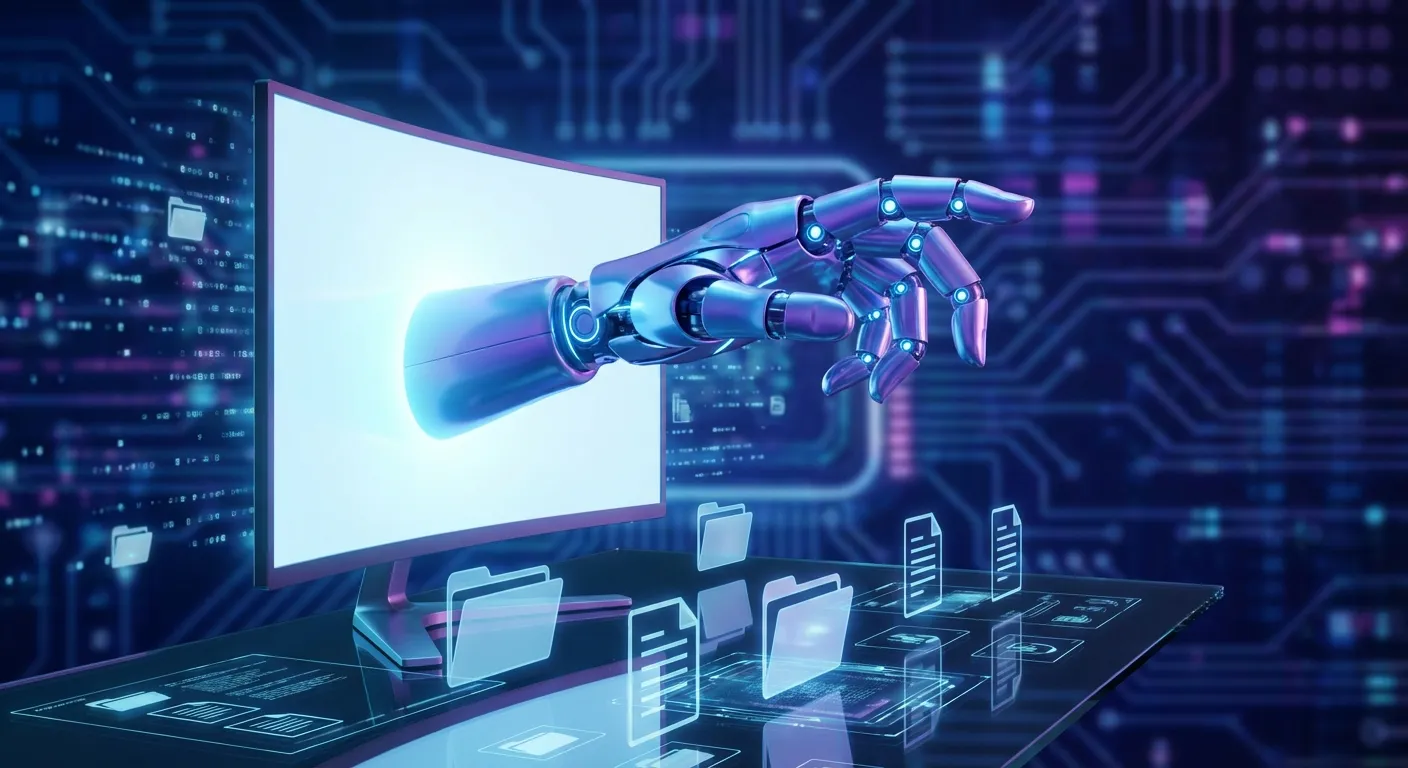
Remember when AI was just a chatbot in a browser tab? Those days are officially over.
Meta’s Manus dropped a desktop app yesterday that does something no mainstream AI product has dared to do at scale: it takes control of your computer. Not “suggests things you could do” control. Not “here’s a helpful link” control. Actual, direct access to your files, folders, and applications.
This is not a drill. The AI agents are moving in.
From Cloud to Castle
Manus started as a cloud-based agent—impressive, but contained. You’d interact through a browser, it would do its thing on remote servers, and your local machine remained untouched. Safe. Predictable.
The new desktop app blows that containment wide open with a feature called “My Computer.” Yes, really. The name tells you everything about the ambition. Once you grant permission, Manus can:
- Read and edit your documents
- Organize your file system
- Launch applications
- Work inside coding environments
- Execute multi-step workflows across your entire machine
The company claims you can ask Manus to sort thousands of images on your hard drive or generate entire applications in minutes by working directly in your development environment. This isn’t an assistant. It’s closer to a digital employee with a key to your office.
The $2 Billion Question
Meta acquired Manus late last year for roughly $2 billion. At the time, skeptics wondered what Meta saw in yet another AI startup. Now it’s clear: they were buying the trojan horse.
The desktop app integrates with Meta’s broader AI ecosystem, including the Meta AI assistant. The play is obvious—get Manus running on your machine, and suddenly Meta’s AI isn’t just answering questions. It’s doing things. On your behalf. With your files.
There’s a certain irony in Meta, a company that’s spent a decade monetizing your attention, now asking for access to your file system. The value proposition is compelling: an agent that handles tedious tasks could save hours. But the data implications are… let’s say, worth thinking about.
The OpenClaw Factor
Here’s where things get spicy. Manus isn’t alone in this space. OpenClaw, an open-source AI agent that runs locally, has been gaining traction fast. It’s MIT licensed, has a rabid developer community, and—crucially—doesn’t phone home to a $1.5 trillion advertising company.
Jensen Huang recently called OpenClaw “the next ChatGPT” on CNBC’s Mad Money. That’s the NVIDIA CEO effectively anointing an open-source project as the future of AI agents. OpenClaw’s founder, Austrian developer Peter Steinberger, has since joined OpenAI, which adds another layer of complexity to this emerging battlefield.
The contrast couldn’t be starker:
- Manus: Closed source, paid service, Meta-owned, integrated with Meta’s ecosystem
- OpenClaw: Open source, free, community-driven, local-first
This is shaping up to be the Android vs. iOS of AI agents. Except the stakes are higher because we’re talking about software that can literally control your computer.
The Security Question Nobody Wants to Answer
Let’s be real: giving AI access to your file system is a security researcher’s nightmare.
Manus says users “remain in control” through permission settings. You can choose “Allow Once” for one-time actions or “Always Allow” for recurring workflows. Sounds reasonable. But we’ve seen this movie before. How many people actually read permission dialogs? How many will just click “Always Allow” because it’s easier?
The attack surface expands dramatically when AI agents can interact with local files and applications. Prompt injection attacks—where malicious content tricks an AI into taking harmful actions—become exponentially more dangerous when the AI has real capabilities instead of just generating text.
I’m not saying Meta’s engineering is bad. I’m saying this is uncharted territory, and the incentives for the company to move fast are very different from the incentives for users to be cautious.
The Bigger Picture
What’s actually happening here is a fundamental shift in how we interact with computers. For decades, the interface was clear: you tell the computer what to do, the computer does it. Every action required your explicit input.
AI agents flip this model. You describe an outcome, and the agent figures out the steps. That’s enormously powerful for productivity. It’s also a philosophical shift in who—or what—is actually operating your machine.
Meta isn’t alone in this race. Microsoft’s been pushing Copilot into Windows. Google’s ambient computing vision is essentially agents everywhere. Apple, characteristically, is rumored to be cooking something up for a future macOS release.
The desktop app isn’t the destination. It’s the beachhead.
My Take
I’m genuinely torn on this one.
The capability is undeniably useful. Anyone who’s spent hours organizing files, setting up development environments, or managing repetitive workflows knows the appeal. Having an AI that can just do those things sounds like magic.
But I can’t shake the feeling that we’re normalizing something we don’t fully understand. The speed at which these tools are being deployed—from “interesting research” to “running on your machine” in under two years—doesn’t leave much room for understanding the second-order effects.
Meta paying $2 billion for this technology tells you everything about where the industry thinks value is heading. The race is on to become the default operating layer between humans and their computers. Whoever wins that race gains influence that makes the browser wars look quaint.
For now, I’d recommend trying Manus if you’re curious but treating it like you’d treat any software with deep system access: carefully, with limited permissions, and with a clear understanding that the company behind it has business interests that may not align perfectly with your privacy interests.
The AI agents are here. The question is whether we’re ready to let them in.
What’s your take on AI agents controlling your desktop? Are we moving too fast, or is this the natural evolution of computing? Hit me up on Telegram @devdigestnow.