A billion dollars used to build companies. Now it launches arguments.
On March 10, 2026, Yann LeCun’s Advanced Machine Intelligence Labs — AMI Labs — closed a $1.03 billion seed round at a $3.5 billion pre-money valuation. For context, this is Europe’s largest seed round ever. The investor list reads like a who’s who of tech money: Cathay Innovation, NVIDIA, Bezos Expeditions, Temasek, Samsung, Toyota Ventures, plus individual backers including Jeff Bezos, Mark Cuban, Eric Schmidt, and Tim Berners-Lee.
But here’s the twist that makes this story fascinating: LeCun didn’t raise a billion dollars to build a better ChatGPT. He raised it to prove that the entire LLM paradigm — the foundation of OpenAI, Anthropic, Google’s Gemini, and virtually every AI company in the spotlight — is fundamentally wrong.
The Man Who Called Bullshit
If you’ve followed AI discourse at all, you’ve seen Yann LeCun’s takes. The Turing Award laureate and former Meta Chief AI Scientist has spent the last three years publicly arguing that large language models are “doomed” when it comes to achieving anything resembling general intelligence.
His argument is deceptively simple: predicting the next token in a sequence doesn’t require understanding the world. A parrot can mimic speech without comprehending meaning. GPT can write poetry without understanding what a poem is. Claude can explain physics without having any concept of how objects actually move.
LeCun believes today’s most celebrated AI systems are, at their core, sophisticated autocomplete engines. Useful? Absolutely. Transformative for certain tasks? Sure. But a path to AGI? Not a chance.
And now he has a billion dollars to prove it.
World Models: The Alternative Vision
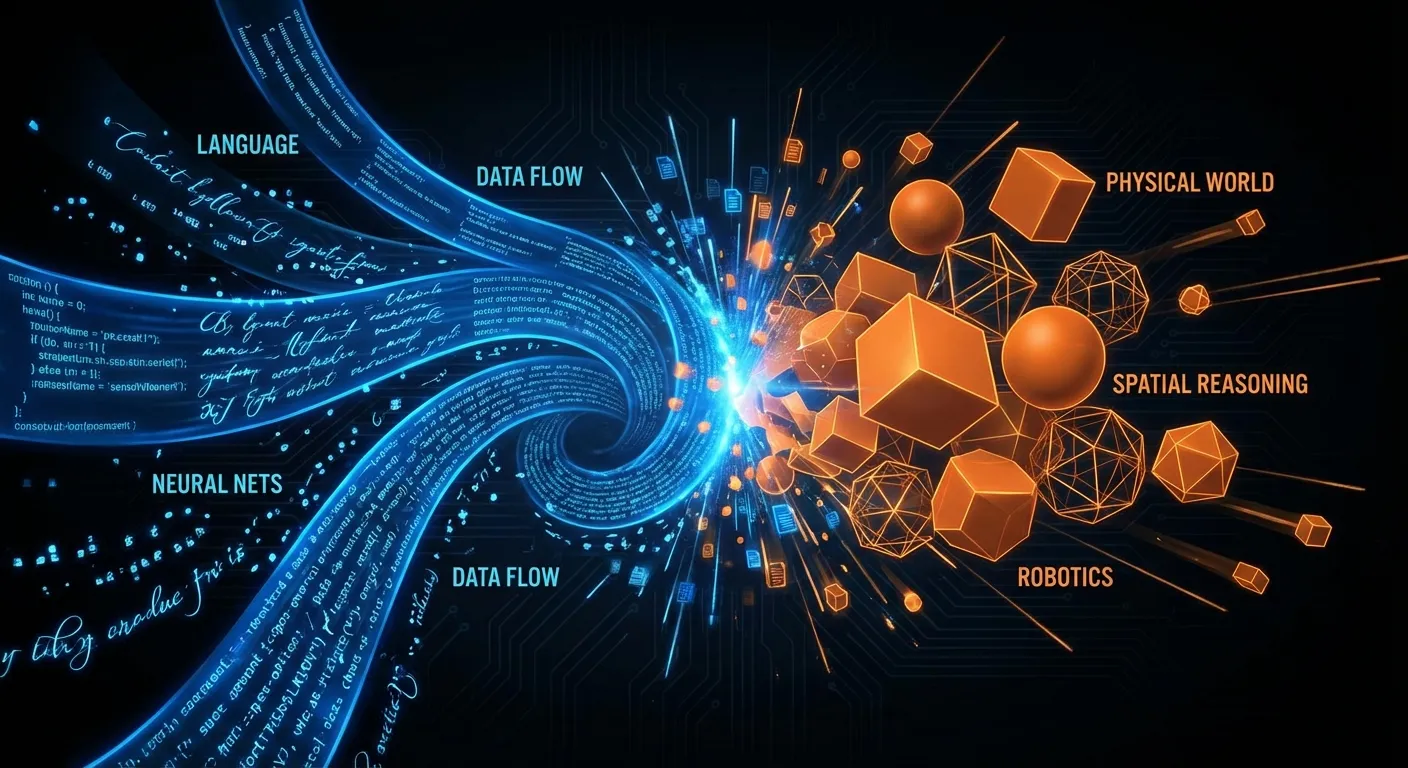
AMI Labs is building what LeCun calls “world models” — AI systems that don’t just predict text patterns but construct internal representations of physical reality. The technical foundation is JEPA: Joint Embedding Predictive Architecture.
The core insight is counterintuitive. Generative models (like GPT) try to predict the future state of the world in high-dimensional detail — pixel by pixel, token by token. But much of what happens in reality is inherently unpredictable at that granular level. When you throw a ball, you don’t mentally simulate every air molecule. You understand trajectories, physics, cause and effect.
JEPA trains models to make predictions in abstract representation space. Instead of asking “what’s the next word?” it asks “what matters about how this situation will change?” This, LeCun argues, is how biological intelligence actually works — and it’s the only path to machines that can genuinely reason, plan, and understand the world.
The Team
LeCun didn’t just bring money. He brought talent.
Alexandre LeBrun serves as CEO — the former founder of Wit.ai (acquired by Facebook in 2015) who spent years working alongside LeCun at Meta. Saining Xie is Chief Science Officer, bringing deep computer vision expertise. Pascale Fung leads research and innovation, with a background in conversational AI and multimodal systems.
The team is deliberately small — roughly a dozen employees — but LeBrun has been explicit that AMI isn’t a typical startup with a six-month revenue runway. The first year is focused purely on research. Product timelines are measured in years, not quarters.
The Strategic Positioning
There’s something else going on here that matters: geography.
AMI Labs is headquartered in Paris, with hubs in New York, Montreal, and Singapore. LeCun has been vocal about the company’s European identity being intentional. “We’re one of the few frontier AI labs that is neither American nor Chinese,” he noted.
This isn’t just nationalism. It’s strategy.
European governments, sovereign wealth funds, and enterprise buyers are actively seeking AI infrastructure that doesn’t route through US hyperscaler supply chains. The EU’s AI Act creates regulatory frameworks that favor European-aligned companies. French institutional backing (via Cathay and Bpifrance) positions AMI as a sovereign AI play — something that matters enormously for defense, healthcare, and critical infrastructure applications where data jurisdiction concerns are real.
NVIDIA’s participation signals alignment with compute infrastructure. Toyota and Samsung point toward industrial and device applications. This investor syndicate was carefully constructed, not assembled through FOMO.
The Bull Case
If LeCun is right, the implications are staggering.
Today’s LLM-focused companies — including OpenAI with its $110 billion raise last month — are building on sand. Their models will hit capability ceilings that no amount of scaling can overcome. Meanwhile, AMI’s world models will enable robots that actually understand physics, medical AI that genuinely reasons about patient health, and autonomous systems that can safely navigate unpredictable environments.
Industrial applications are the natural fit. Manufacturing, logistics, robotics — domains where hallucinations carry real costs and “good enough” language understanding isn’t enough. Healthcare, where reliability matters more than creativity. Self-driving cars, where understanding cause and effect isn’t optional.
If world models work, AMI could own the next paradigm while everyone else is still scaling the current one.
The Bear Case
Let’s be honest about the risks.
A billion dollars is a lot. But OpenAI raised $110 billion. The resource asymmetry is staggering. If LLMs get “good enough” at physical reasoning through sheer scale and multimodal training — GPT-5 with vision already reasons about images with decent accuracy — the separate world model thesis weakens.
Moreover, world models have their own generalization challenges. The path from laboratory JEPA demonstrations to reliable real-world deployment in healthcare or robotics is non-trivial. Many well-funded research labs have historically struggled at exactly this transition.
And then there’s timing. LeCun is explicit that meaningful product timelines are years away. A lot can change in years. The AI landscape of 2028 might look nothing like today’s — and not necessarily in AMI’s favor.
My Take
Here’s what fascinates me about this story: it’s not really about money. It’s about what kind of future we want.
The LLM paradigm — ChatGPT, Claude, Gemini — has given us tools that feel magical but are fundamentally about language and patterns. They’re incredibly useful for writing, coding, analysis, conversation. But they’re built on token prediction, not world understanding.
LeCun is betting that this distinction matters. That at some point, the parrot metaphor breaks down. That systems which don’t actually understand physics can’t safely drive cars, can’t reliably perform surgery, can’t reason about complex industrial processes.
Is he right? I genuinely don’t know. The LLM believers would argue that emergent capabilities keep surprising us, that scale solves problems we thought were fundamental. The world model camp would say that’s just cargo culting — impressive results without genuine understanding.
What I do know is this: we need people making these contrarian bets. A world where everyone builds the same architecture, scales the same paradigm, and assumes the same future is a world that misses fundamental breakthroughs.
Yann LeCun just raised a billion dollars to ask a different question. Whatever happens next, that matters.
AMI Labs operates across Paris, New York, Montreal, and Singapore. The company has not announced specific product timelines.