On Thursday, federal agents arrested Yih-Shyan “Wally” Liaw, a 71-year-old Silicon Valley veteran who co-founded Supermicro back in 1993 and remains close to its CEO Charles Liang. The charges? Allegedly masterminding a $2.5 billion scheme to smuggle AI servers packed with coveted Nvidia GPUs into China, in direct violation of U.S. export controls.
The stock crashed 33% on Friday. And honestly? That might be just the beginning.
The Scheme: Hair Dryers and Dummy Servers
The Department of Justice indictment reads like a spy novel, except it’s real and involves some of the most valuable technology on Earth.
Here’s how authorities say it worked:
Liaw allegedly coordinated with Supermicro’s Taiwan general manager Ruei-Tsang “Steven” Chang (currently a fugitive) and a third-party fixer named Ting-Wei “Willy” Sun to route servers through an unnamed Southeast Asian company. That company would place purchase orders with Supermicro as if the servers were for their own operations.
Once assembled in the U.S. and shipped to Taiwan, the servers would arrive at the Southeast Asian company—where they’d be quickly stripped of identifying packaging, placed in unmarked boxes, and forwarded to their true destination: China.
But here’s where it gets wild.
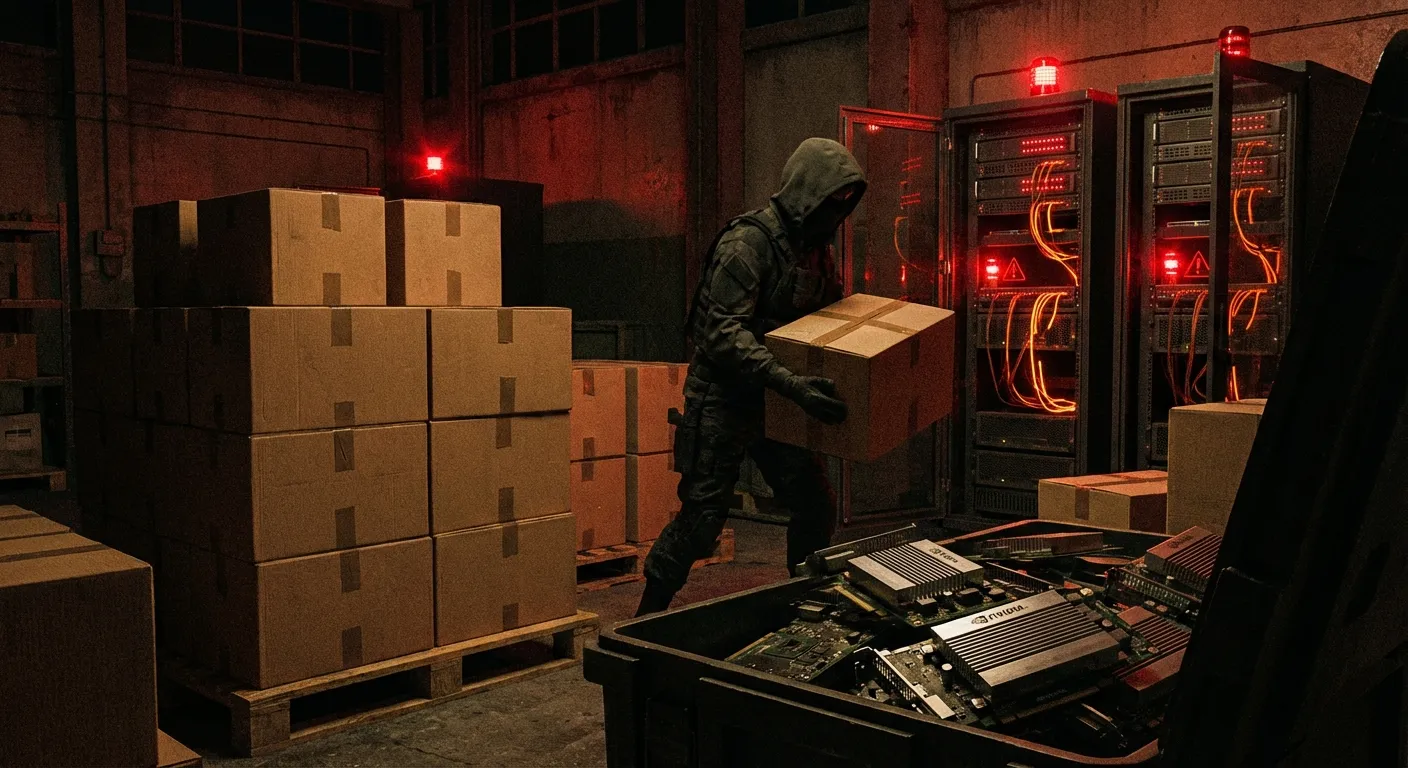
To keep Supermicro’s compliance team from catching on, the defendants allegedly staged thousands of physical dummy servers at the Southeast Asian warehouse. Surveillance footage shows Sun and an unnamed co-conspirator using hair dryers to carefully peel off serial number stickers from real servers and reapply them to fakes. These decoys sat on shelves to pass inspections while the actual hardware was already running AI workloads somewhere in China.
The same dummy servers were later used to fool a U.S. Department of Commerce audit.
During a three-week period from late April to mid-May 2025, prosecutors say approximately $510 million in servers were shipped to China. The defendants allegedly used encrypted messaging apps to discuss delivery locations, quantities, and ways to evade detection.
Why This Matters
Nvidia’s GPUs are the oxygen of the AI revolution. Training frontier models requires thousands of them. The U.S. government has been trying to prevent China from obtaining this hardware without authorization precisely because AI capability is becoming a geopolitical chessboard.
The export controls exist for a reason. As Assistant Attorney General John A. Eisenberg put it: “The indictment details alleged efforts to evade U.S. export laws through false documents, staged dummy servers to mislead inspectors, and convoluted transshipment schemes, in order to obfuscate the true destination of restricted AI technology—China.”
And this isn’t some random middleman operation. This is a co-founder of a major publicly-traded server company—someone with deep ties to Nvidia’s ecosystem. Supermicro CEO Charles Liang has frequently touted his close business relationship with Jensen Huang. The servers flowing through this alleged scheme were stuffed with the same chips powering OpenAI, Anthropic, and every other frontier lab.
Supermicro’s Troubled History
If you’ve been following Supermicro, the company’s governance issues aren’t exactly new.
Trading was suspended in 2018 after the company fell out of Nasdaq compliance while the SEC investigated its accounting practices. Liaw resigned all positions that year following an internal audit committee investigation. In 2020, Supermicro paid a $17.5 million penalty.
And yet—Liaw returned. First as an adviser in 2021, then as a senior executive in 2022, and back on the board by December 2023. Fast forward to August 2024, when short-seller Hindenburg published a scathing report alleging the accounting issues had returned. Then in October 2024, auditor Ernst & Young resigned, raising serious concerns. BDO was brought in as a replacement.
Now a co-founder is in federal custody for allegedly running a multi-billion-dollar smuggling operation.
The pattern here is hard to ignore. Each time governance red flags appeared, they were dismissed or minimized. Now we’re looking at what prosecutors call the “highest-profile crackdown on alleged smuggling of restricted AI technology.”
The Bigger Picture
Here’s what keeps me up at night about this story.
We’ve been debating for months whether export controls actually work. China has been finding ways to acquire compute—through cloud providers, through third countries, through creative engineering with lower-spec chips. DeepSeek’s emergence as a credible competitor to American AI labs suggested that maybe restrictions weren’t the bottleneck we thought they were.
But this indictment shows the scale of effort required to circumvent those controls. Dummy servers. Hair dryers. Encrypted chats. Southeast Asian shell arrangements. Physical surveillance of auditors to time the staging. This wasn’t a loophole—it was allegedly an industrial-scale operation to defeat American policy.
And if a co-founder of a major U.S. server company was allegedly willing to take these risks, what does that tell us about the economic incentives involved?
The Trump administration is in an awkward position here. Just last week, Nvidia CEO Jensen Huang announced that chipmaker is restarting manufacturing to fulfill H200 orders from China—orders blessed by the government under Trump’s “conditions” approach. Meanwhile, the DOJ is prosecuting alleged smuggling of similar technology.
What Happens Next
Liaw faces serious federal charges. The other Taiwan-based defendant remains a fugitive. Supermicro has placed employees on leave and is “cooperating with the investigation.”
But the real fallout extends beyond one company.
Every server maker just got a wake-up call about end-user verification. Nvidia’s spokesperson emphasized that “unlawful diversion of controlled U.S. computers to China is a losing proposition”—they don’t service or support such systems. But the indictment shows how determined actors can work around those limitations.
For the AI ecosystem, this is another reminder that the chips powering our industry are also weapons in a broader technology competition. Export controls are only as effective as the compliance programs enforcing them. And when billions of dollars are on the line, the temptation to look the other way is enormous.
The sobbing emoji that Liaw allegedly sent when he saw news about other chip smugglers getting arrested? That’s the moment when someone realizes the game is up.
The DOJ seems determined to make sure others get the message.
The indictment was unsealed in Manhattan federal court on Thursday. Liaw and Sun were arrested the same day. Chang remains at large.