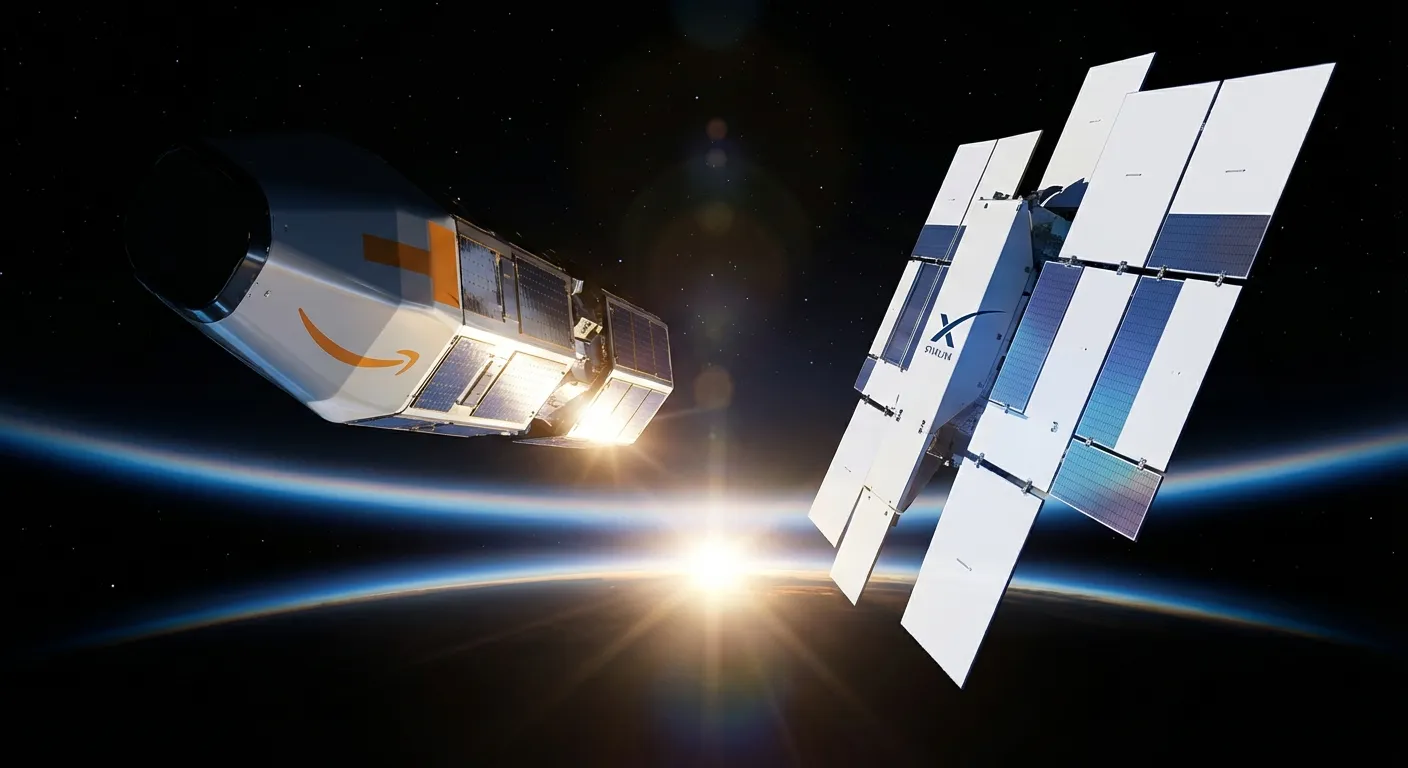
The richest men on Earth are fighting over the sky.
Amazon is in advanced talks to acquire Globalstar, a Louisiana-based satellite telecommunications company, for approximately $9 billion. The deal, first reported by the Financial Times on April 1st, sent Globalstar shares soaring 24% in after-hours trading. But this isn’t just another tech acquisition—it’s Jeff Bezos making his boldest move yet in the space internet war against Elon Musk.
The Starlink Problem
Let’s be honest about where Amazon stands: they’re getting crushed.
Amazon’s satellite internet project, originally called Project Kuiper and now rebranded as Leo, has roughly 200 satellites in orbit. Musk’s Starlink? Over 10,000. That’s not a gap—it’s an embarrassment for a company with Amazon’s resources.
Starlink already serves more than 9 million users globally and generates 50-80% of SpaceX’s total revenue. While Amazon has been methodically building infrastructure and signing deals with airlines like Delta and JetBlue for in-flight WiFi (launching 2027-2028), Musk has been launching Starlink satellites at a pace that makes competitors look like they’re moving in slow motion.
Amazon even had to ask the FCC in February to extend its satellite launch deadline by two years. They’re planning to put 700 satellites in orbit by mid-2026, but they’re struggling with launch capacity. Meanwhile, SpaceX has the unfair advantage of… owning its own rockets.
Why Globalstar?
This is where the Globalstar acquisition makes strategic sense. Amazon isn’t just buying a company—they’re buying time.
Globalstar brings three things Amazon desperately needs:
1. Spectrum licenses. Globalstar holds L-band and S-band spectrum licenses, which are internationally protected resources for mobile satellite services. You can’t just buy these on the open market. They’re among the scarcest commodities in telecommunications.
2. Existing infrastructure. More than 20 global gateway stations, 24 second-generation satellites already in orbit, and a third-generation constellation slated for launch. This is operational, battle-tested infrastructure that Amazon can integrate rather than build from scratch.
3. Operational expertise. Globalstar has been doing this since 1991. They’ve been through bankruptcy, restructuring, and revival. They know where the pitfalls are.
For Amazon, $9 billion is essentially “trading capital for time”—bypassing years of spectrum applications, ground station construction, and regulatory hurdles to acquire mature operational capabilities immediately.
The Apple Problem
There’s a catch, and it’s a big one: Apple owns 20% of Globalstar.
In November 2024, Apple invested $1.5 billion in Globalstar—$400 million for equity and $1.1 billion in infrastructure prepayments. In exchange, Apple secured access to approximately 85% of Globalstar’s satellite network capacity. This is what powers the iPhone’s Emergency SOS via satellite feature, available on iPhone 14 and later.
Under typical corporate governance rules, a 20% stakeholder has significant influence over major decisions like acquisitions. Apple could effectively veto this deal if they wanted to.
The question is: why would Apple let Amazon take over their satellite infrastructure partner?
Apple’s investment was strategic, not financial. They’re using satellite connectivity as a differentiating feature for iPhone and Apple Watch. If Amazon acquires Globalstar and shifts priorities toward competing with Starlink in consumer broadband, Apple’s user experience could suffer.
That said, Apple’s position has appreciated more than 40x since their initial investment (Globalstar was around $1.50 when Apple bought in; it’s now near $68). That’s a monster return. The question is whether the financial gain outweighs the strategic value of keeping satellite SOS as an Apple-exclusive feature.
My bet: Apple will negotiate hard for guaranteed capacity commitments and possibly anti-compete clauses before blessing any deal. They might even demand Amazon subsidize continued iPhone integration as a condition of exit.
The Billionaire Space Race Gets Real
Let’s zoom out for a second.
Jeff Bezos founded Blue Origin in 2000. Elon Musk founded SpaceX in 2002. For over two decades, these two have been in an unspoken competition to dominate commercial space.
But Musk has been winning. SpaceX launches more rockets than anyone else on Earth. Starlink is profitable. Blue Origin is still struggling to achieve consistent orbital launches. The gap between their space ambitions has become almost comical.
The Globalstar acquisition changes that dynamic, at least in the satellite internet sector. Amazon doesn’t need to catch SpaceX in launch capability if they can buy their way to competitive satellite infrastructure.
This is Bezos playing his strength: capital deployment. Amazon has always been willing to lose money for years to dominate a market. AWS ran at a loss while establishing cloud computing dominance. Amazon’s retail operation operated on razor-thin margins while destroying competitors. The playbook is clear.
With Globalstar, Amazon could accelerate Leo deployment, leverage existing spectrum and ground stations, and compete with Starlink by 2027-2028—right when their airline partnerships go live.
What This Means for the Market
If this deal closes, expect consolidation across the satellite industry. Globalstar had previously held sale discussions with SpaceX (ironic, given they might end up competing against them). Other satellite operators will suddenly look like acquisition targets.
The LEO satellite market is transitioning from a “technical validation phase” to a “commercial consolidation phase.” The big players are realizing that building everything from scratch takes too long. Buying existing operators with spectrum licenses and infrastructure is faster.
For consumers, this could eventually mean real competition in satellite internet. Starlink has been essentially alone in the market for consumer LEO broadband. Amazon entering as a credible competitor could drive down prices and improve service—the classic benefits of capitalist competition.
For investors, watch Apple’s response carefully. If they signal willingness to sell or even negotiate, this deal is probably happening. If Apple plays hardball, it could drag on for months or collapse entirely.
The Verdict
Amazon’s potential $9 billion Globalstar acquisition is the most significant development in the space internet race since Starlink went commercial. It’s Bezos acknowledging that Amazon is behind and using his greatest weapon—virtually unlimited capital—to catch up.
Will it work? The satellite internet market is still nascent enough that Amazon could become a dominant player even starting from behind. But executing this acquisition requires navigating Apple’s strategic interests, integrating complex infrastructure, and actually launching the remaining satellites.
Musk has a head start measured in years and thousands of satellites. Bezos has $9 billion and a willingness to spend more. This is going to be one hell of a competition.
The sky isn’t big enough for both of them. And that might be exactly what makes it interesting.